Your cart
There are no more items in your cart
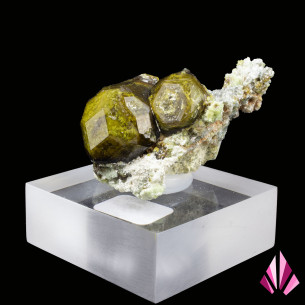
The term garnet does not refer to a single mineral species, but to a group of closely related minerals. Garnets are widely collected for their broad range of colours, their varied geological settings, and their distinctive crystal shapes. In a “Garnets” category, you will therefore see specimens whose appearance can differ significantly, even when the crystals look similar at first glance.
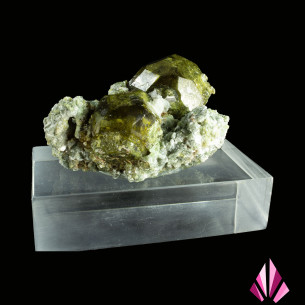
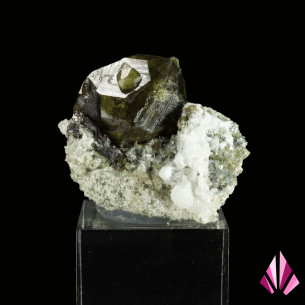
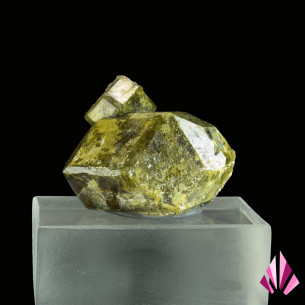
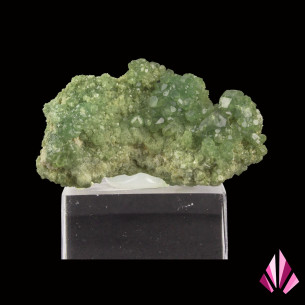
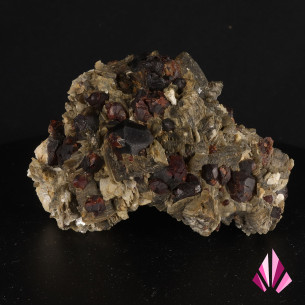
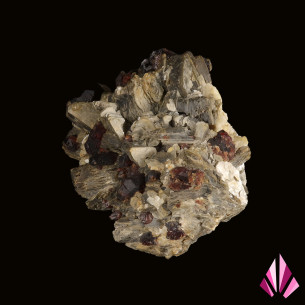
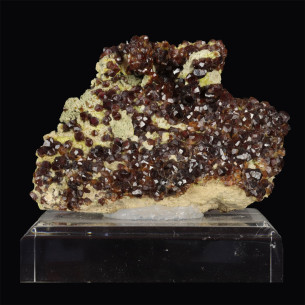
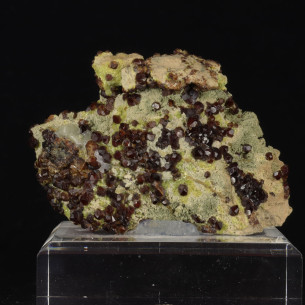
The garnet specimens presented below illustrate this diversity of shapes, hues and mineralogical contexts.
This diversity invites a careful way of looking: a garnet is best compared through observable criteria (shape, edges, surface condition, transparency, mineral associations, and matrix) rather than by name alone. The aim is not to chase a single “best” standard, but to choose a specimen that matches what you want to study: a crisp crystal habit, a readable colour, a typical association, or a clearly identifiable geological context.
A distinctive feature of garnets is that they are often compositionally variable minerals. They form solid-solution series in which certain chemical elements can partially substitute for others. In practical terms, this can affect colour, density, and transparency, sometimes even within a single crystal (colour zoning, gradual transitions). This “family” behaviour helps explain why two garnets of similar shape can display very different visual results.
From a crystallographic standpoint, garnets most commonly crystallise in the cubic (isometric) system. In collections, this is often expressed through recognisable habits: dodecahedra (12 faces) and trapezohedra (24 faces), sometimes in combination. Depending on the locality, faces can be sharp and well defined, or softened, striated, matte, or partly covered by matrix.
Garnets are generally hard (often around 6.5 to 7.5 on the Mohs scale depending on the variety), which makes them suitable for both display and close study. A key point for collectors is that garnet shows no strong cleavage, but it can display a clean fracture (often conchoidal to uneven). This means a crystal can be robust overall while still showing small nicks along edges or local impacts, especially on specimens with prominent, sharp ridges.
Lustre varies widely (vitreous to resinous in many cases). Transparency is also highly variable: some garnets are translucent to transparent, while others are distinctly opaque. This depends on composition as well as inclusions, micro-fractures, and naturally satin or matte surfaces.
1) Habit and face definition. For a “readable” garnet, look for an identifiable habit (dodecahedron/trapezohedron) with faces flat enough to show geometry clearly. If you prefer more “geological” pieces, a crystal partly embedded in matrix can be more informative than a fully isolated crystal.
2) Edges and integrity. Check the edges: minor marks can be normal, but heavily damaged edges change how the crystal reads. In some localities, slightly softened edges can also reflect natural growth features or surface alteration rather than mishandling.
3) Colour, and above all colour readability. Garnets span a wide spectrum (reds, browns, oranges, greens, sometimes very dark tones). The key is not to expect a “pure” colour, but to observe a coherent hue, stable saturation, or, if you prefer, an interesting zoning. In photos and in hand, colour depth often depends on thickness: a dark garnet may show brighter edges where light passes through more easily.
4) Mineral associations and matrix. A garnet can become much more instructive when accompanied by “context” minerals: quartz, micas, feldspars and schists in many metamorphic settings; calcite, diopside, vesuvianite and other skarn-related minerals depending on the deposit. The matrix is not merely a support; it helps explain formation.
Using “garnets” in the plural is often the most accurate, because the word refers to a group. Names such as almandine, pyrope, spessartine, grossular, andradite or uvarovite refer to composition end-members and to common appearance patterns, but a real specimen can sit between two end-members. This is one reason why specimens within the same broad colour family can look quite different.
Depending on the deposit, garnets may occur as isolated crystals, clusters on matrix, or crystals included in rock. Localities are therefore most useful as reading aids: certain settings produce very regular habits, while others favour aggregates, matte surfaces, or characteristic mineral associations. Understanding a locality often helps anticipate the crystallisation style, the typical matrix, and the kind of observation a specimen supports (geometry, colour, associations, geological context).
When browsing this Garnets category, the most effective approach is to compare specimens using stable criteria: habit readability, edge condition, surface quality, colour coherence, and the mineralogical interest of the matrix. This framework helps you choose a garnet for what it shows, not only for what it represents.