Your cart
There are no more items in your cart
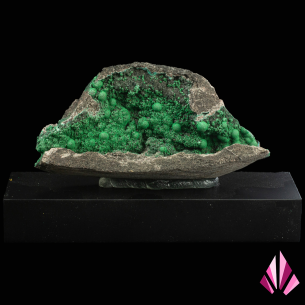
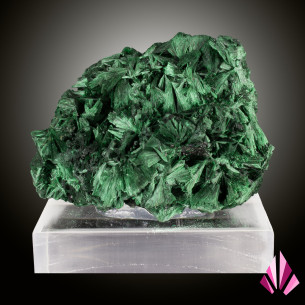
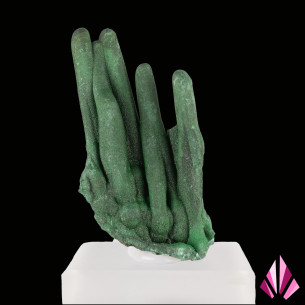
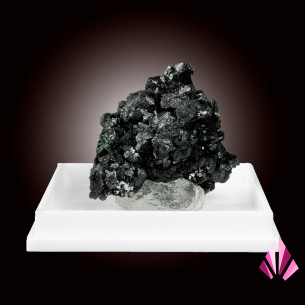
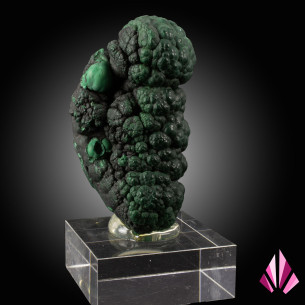
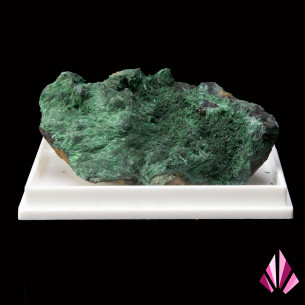
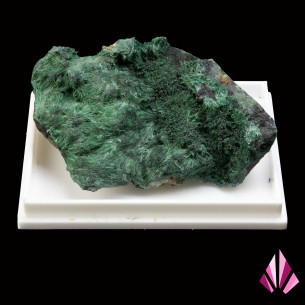
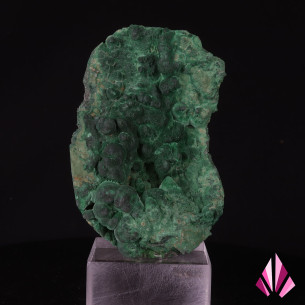
Malachite is a mineral composed of copper carbonate, with the chemical formula $Cu_{2}CO_{3}(OH)_{2}$, belonging to the monoclinic crystal system. It forms naturally in the oxidation zones of copper deposits, where surface waters rich in oxygen and carbon dioxide interact with the surrounding rocks. For the collector, malachite offers a unique visual experience due to its diverse habitus: it can appear as acicular crystals (fine needles), botryoidal masses with smooth curves, or spectacular stalactitic structures.
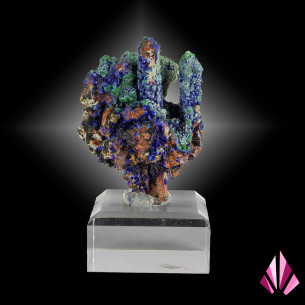
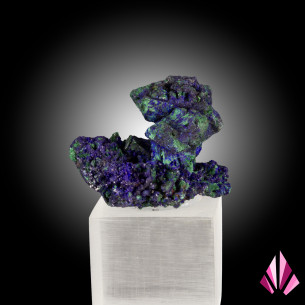
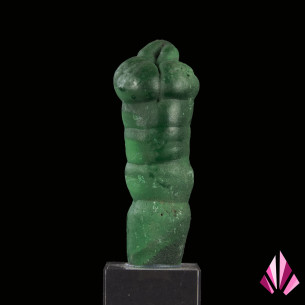
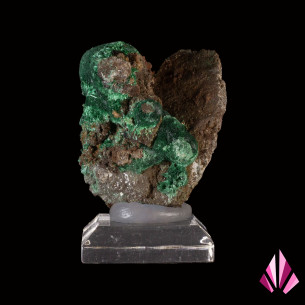
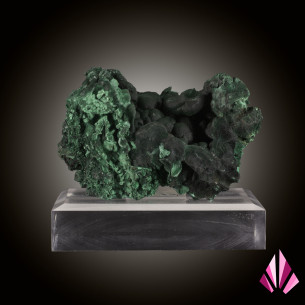
The malachites presented below illustrate this diversity of appearances and contexts: shapes, colors, origins, and mineral associations.
The majority of current collector specimens come from the "Copperbelt" in Central Africa, specifically from the Democratic Republic of the Congo (DRC). The mines of Katanga are world-renowned for the quality of their malachites, offering pieces with stunning geometric shapes. These include both massive stalactites and so-called velvet facies, whose silky luster is created by a multitude of micro-needles playing with light. While other historical deposits exist in Morocco or Arizona, the DRC remains the global benchmark for the diversity of forms and paragenesis.
The identification of malachite is based on stable physical properties. Its hardness ranges between 3.5 and 4 on the Mohs scale, making it a relatively soft mineral, sensitive to scratches and impacts. A major observation criterion lies in its internal structure: when polished or broken, it reveals concentric growth zones. These bands, alternating between light green and forest green, bear witness to chemical variations during its slow crystallization. Examining the crystal terminations, when visible, helps distinguish the silky brilliance of fibrous forms from the more matte appearance of massive forms.
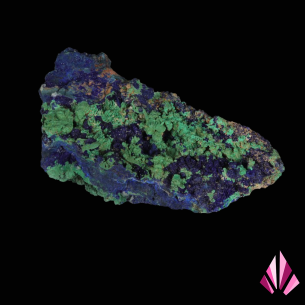
In its natural environment, malachite is rarely found alone. It is common to observe specimens where the green of the malachite contrasts with the deep blue of azurite, the blue-green of chrysocolla, or the vibrant green of dioptase. These associations are valuable indicators for understanding the geological context of the deposit. To preserve your collection, note that malachite is sensitive to heat and acids. Cleaning with water is possible but must be brief and followed by immediate drying, especially for velvet facies where fragile needles can trap moisture. The use of chemical products is strictly prohibited to avoid altering its natural luster.