Your cart
There are no more items in your cart
Barite, also known as baryte, is a barium sulfate mineral (BaSO₄) appreciated by collectors for the diversity of its crystal forms. It crystallizes in the orthorhombic system and commonly occurs as tabular or bladed crystals, either isolated, superimposed or grouped together. Its high density is also one of its most distinctive physical characteristics.
The barite specimens currently available are displayed a little further down this page. You will find several collectible pieces with photos, videos, dimensions and provenance information.
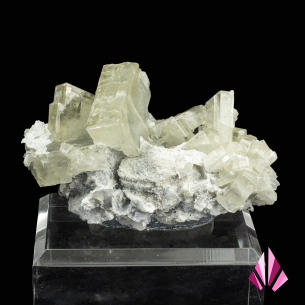
Barite crystals may display well-defined flat faces, regular stacks of blades or more complex groups. Their appearance can vary significantly from one specimen to another depending on the crystallization conditions. Barite also has distinct cleavage, which may result in delicate edges or small breaks on certain parts of the crystals.
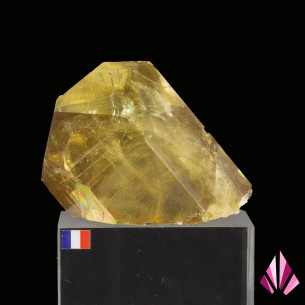
Its colour is often white, beige or honey-toned, although other shades may occur depending on inclusions and the mineralogical environment. Transparency, crystal shape, crystal arrangement and the presence of matrix are all useful characteristics when comparing different specimens.
When examining a barite specimen, useful features include the sharpness of the crystals, the regularity of the blades, their orientation, their state of preservation and the overall structure of the piece. Two specimens with similar colours may therefore display very different crystallizations.
Barite is also found in association with other minerals, including fluorite, calcite, galena and quartz. These associations can produce a wide variety of forms, textures and colours within a single specimen.
This section brings together a selection of barite specimens for sale from different localities, including France, Spain and Bulgaria. Crystal forms, matrices and mineral associations can vary considerably depending on the deposit. Each piece is presented individually so that its characteristics can be examined through detailed photos and videos.