Your cart
There are no more items in your cart

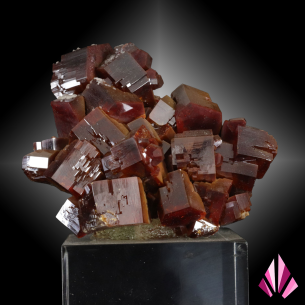
The vanadinite crystals offered by Le Monde Minéral come from the mining district of Mibladen, near Midelt in Morocco, a locality particularly well known among mineral collectors. Our selection includes small vanadinite specimens with finely defined crystals, beautiful associations with baryte, and pieces displaying larger, well-developed crystals. Ranging from orange-red to deep reddish-brown, these natural minerals offer a beautiful variety of crystal formations, including particularly fine hexagonal crystals with sharply defined edges.
Each vanadinite specimen has its own photographs and presentation video.
Vanadinite is easily recognised by its six-sided crystals, often short and stout, sometimes flattened into small tabular forms. Their flat faces can display a particularly bright lustre, while their colours range from vivid red to dark red, with orange or brownish tones.
The Mibladen deposits have produced a wide variety of crystal formations. Some specimens display numerous small crystals closely grouped together, while others feature larger, well-individualised crystals with clearly defined faces and terminations.
One of the most appreciated associations is vanadinite on baryte, also known as barite. Red vanadinite crystals can develop on white or cream-coloured baryte, often forming bladed or fan-shaped crystal groups.
This association brings together two minerals with very different crystal habits: the hexagonal prisms of vanadinite and the bladed crystals of baryte. Our selection includes beautiful vanadinite specimens on baryte, where the red crystals contrast with the pale colours and distinctive formations of the baryte.
Vanadinite is a lead chlorovanadate with the chemical formula Pb5(VO4)3Cl. It belongs to the apatite group and crystallises in the hexagonal crystal system.
It is a secondary mineral that forms mainly in the oxidation zones of lead deposits, where chemical alteration of pre-existing minerals promotes the development of new crystal formations.
Its relatively low hardness of 2.5 to 3 on the Mohs scale contrasts with its high specific gravity of approximately 6.9. Its crystals therefore require careful handling, particularly when they are delicate or attached to thin baryte blades.
Vanadinite takes its name from vanadium, a chemical element present in its composition. The element itself was named after Vanadis, one of the names of Freyja, a goddess in Norse mythology. This name refers to the wide range of colours displayed by vanadium compounds.
Although Moroccan vanadinite specimens are now among the best known, the history of this mineral begins in Mexico, in the mines of Zimapán, where it was first discovered. Vanadinite was described in 1838 by the German mineralogist Franz von Kobell, long before the crystal formations from Mibladen became famous.