Your cart
There are no more items in your cart
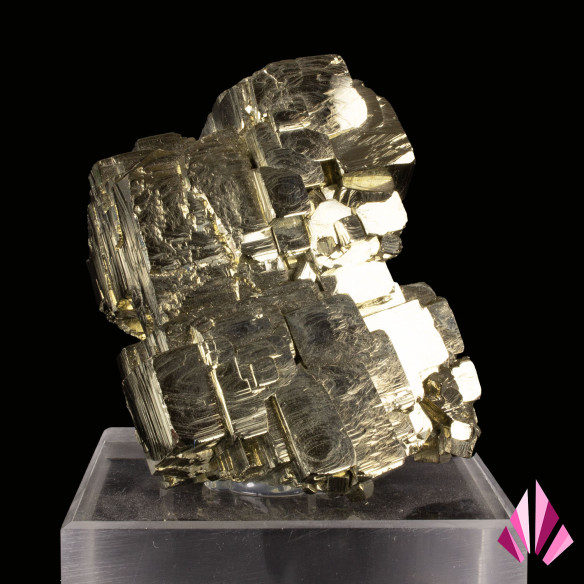
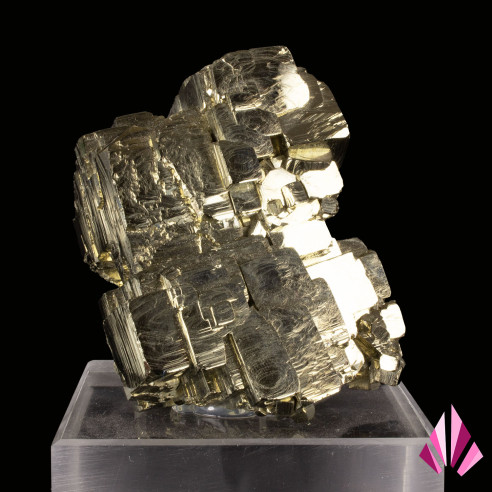


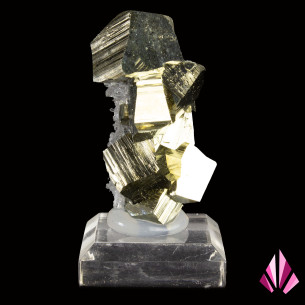
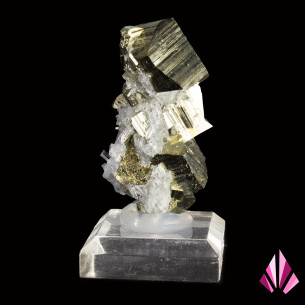
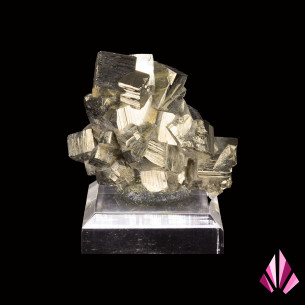
This very fine pyrite from Peru, collected in 2017, forms an upright piece composed of numerous intergrown crystals. Several display massive cubic forms, straight edges, broad highly reflective metallic faces and clearly striated growth steps. On some faces, the striations form particularly visible concentric patterns.
The video shows the crystallisation on the different sides of the piece, with an alternation of large crystals and smaller, closely associated forms. Presented on an acrylic base, the piece measures 76 mm in length, 62 mm in width and 93 mm in height. It weighs 1.300 kg including the base.
About pyrite: this mineral is an iron disulphide with the chemical formula FeS2. It crystallises in the cubic system and has a hardness of 6 to 6.5 on the Mohs scale. Its name comes from the Greek word pyr, meaning “fire”, as pyrite can produce sparks when struck against a hard material.
Its brass-yellow colour and metallic lustre earned it the nickname “fool’s gold”. Many prospectors mistook it for gold before discovering that it was harder, brittle and lacked the malleability of the precious metal. Pyrite was also mined as a source of sulphur dioxide, particularly for the manufacture of sulphuric acid.
View our current range of pyrites in the catalogue.
You might also like